The Sartorial Archive
Discover More:
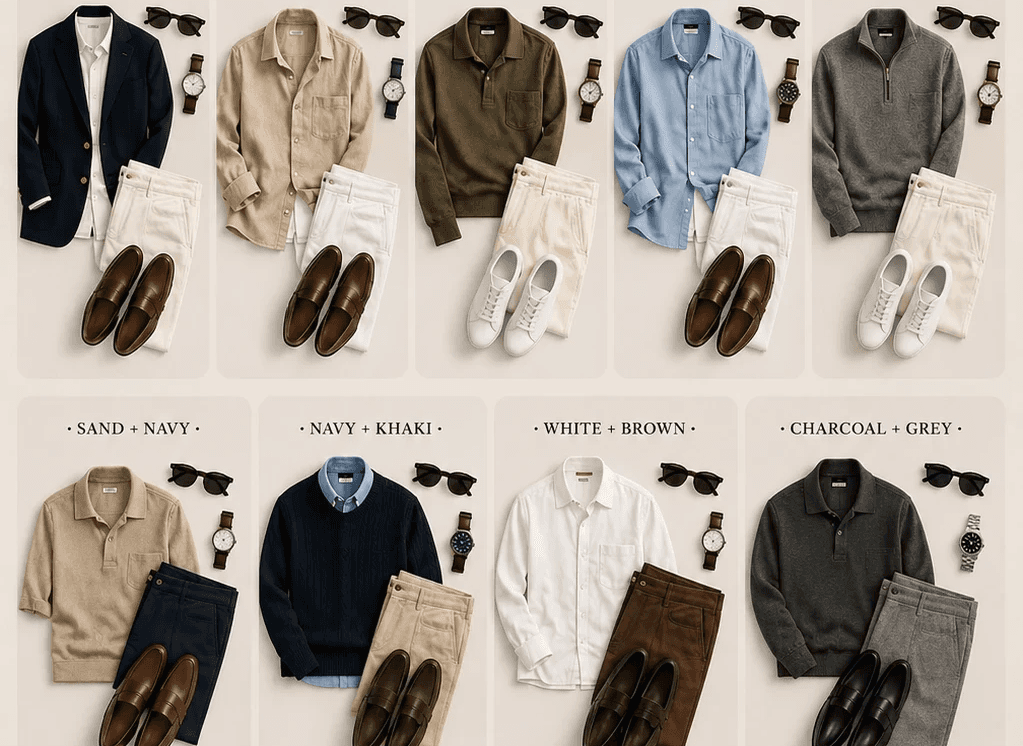
Master Class in Colour Harmony: 9 Essential Outfit Formulas for the Modern Gentleman
True style is never loud. It doesn’t demand attention through flashing logos or fleeting trends; instead, it commands a room through quiet confidence, impeccable fit, and a masterful understanding of colour theory.
When building a timeless capsule wardrobe, the goal is to create maximum versatility with a curated selection of high-quality pieces. Below, we unlock our foundational 9-outfit design matrix, breaking down the exact psychology behind each colour pairing and the historical tailoring pillars that hold them together.
I. The Core 9 Style Breakdowns
I. Navy & Cream
The absolute bedrock of traditional nautical and sartorial elegance. The deep, commanding tone of a navy blazer provides a stark, masculine framing, while the warmth of cream trousers softens the contrast. Unlike a harsh black-and-white pairing, navy and cream mimics natural light and shadow, offering an immediate look of old-world refinement.
II. Beige & White
The epitome of warm-weather sophistication. This combination relies on low-contrast harmony. By pairing a textured beige linen or lightweight cotton shirt with crisp white trousers, you create a seamless, elongated silhouette. It evokes the effortless ease of the French Riviera, looking completely intentional without feeling forced.
III. Olive & Cream
An immaculate study in rugged refinement. Olive drab carries a rich, utilitarian heritage rooted in military tailoring. When juxtaposed against the pristine luxury of cream tailoring, the olive shirt loses its casual, rugged edge and transforms into a highly sophisticated neutral that feels grounded, earthy, and distinctly elegant.
IV. Light Blue & White
Crisp, clean, and eternally classic. Light blue acts as the ultimate canvas in menswear—it flatters almost every skin tone and brings an immediate freshness to the table. Paired with white denim or tailored trousers, this look relies on high clarity and simplicity, making it the perfect uniform for bright, clear days.
V. Grey & Cream
An understated masterpiece of transitional dressing. While charcoal and dark grey can occasionally feel corporate, a mid-to-light grey quarter-zip or knit polo paired with cream trousers bridges the gap between casual comfort and sharp tailoring. The cream warmth cuts through the coolness of the grey, creating an incredibly balanced tonal aesthetic.
VI. Espresso & Stone
Rich, dark brown tones offer an incredibly luxurious alternative to standard black or navy. An espresso-toned linen shirt or knit piece grounds an outfit with immense depth. Pairing it with a muted stone-grey or off-white trouser ensures the dark brown remains the focal point while keeping the overall look light enough for daytime wear.
VII. Sage & Ivory
A softer, highly contemporary take on traditional earth tones. Sage green carries a subtle grey undertone that makes it exceptionally muted and easy on the eye. When combined with the rich, buttery depth of ivory trousers, it creates an elegant, calming aesthetic that speaks to impeccable taste and a subtle deviation from ordinary choices.
VIII. Charcoal & White
The ultimate study in high-contrast monochrome. A deep charcoal grey polo or unlined jacket offers the structure of a dark neutral without the severe, heavy starkness of true black. Set against sharp white trousers, it creates a striking, athletic contrast that feels razor-sharp, modern, and brilliantly clean.
IX. Camel & Navy
A quintessential autumn-through-spring power pairing. Camel inherent warmth and golden undertones possess an undeniable air of luxury. When layered over or paired alongside deep navy blue trousers, the two tones complement each other perfectly on the colour wheel, resulting in a deep, visually compelling depth.
II. The Essential Shoppable Checklist
To construct these nine foundational look book formulas, you do not need an endless closet. Focus entirely on acquiring these core, high-texture staples:
The Navy Unstructured Blazer: Look for hopsack wool or a linen-silk blend with patch pockets to keep it versatile.
The Cream Pleated Trouser: A mid-to-high rise with a distinct single or double pleat to introduce drape.
The Olive Knit Polo: Long or short sleeve, featuring a split-hem or ribbed waistband.
The Crisp White Linen Shirt: Essential for texture; ensure it has a structured collar that can stand beautifully without a tie.
The Light Grey Quarter-Zip: Premium extra-fine merino wool or cashmere with a leather or silver zipper pull.
The Espresso Brown Button-Down: Cut from washed cotton or linen to highlight the rich fabric highs and lows.
The Dark Chocolate Suede Loafer: A timeless slip-on that anchors dark and light outfits with equal ease.
The Clean White Leather Sneaker: Low-profile, minimal branding, and stitched cup-soles for casual variations.
III. The Pillars of Historical Tailoring Advice
A flawless colour palette means nothing if the architecture of the garment fails. To truly embody a timeless aesthetic, your wardrobe choices must respect the historic rules of classic tailoring.
The Power of the Trouser Pleat
For decades, mainstream fast fashion pushed the narrative of the ultra-slim, flat-front trouser. Traditional tailoring, however, honours the pleat. Single or double forward pleats are not just a vintage styling detail; they are functional engineering.
Pleats open up when you sit or move, providing essential comfort and room through the hips and thighs, while allowing the fabric to collapse back into a clean, razor-sharp crease when standing. They add visual weight to your midsection, creating a highly flattering, classic masculine drape.
Fabric Weight: Linen vs. Heavy Cotton
Texture dictates the mood of an outfit.
Linen is the fabric of leisure. It is woven loosely to allow airflow, and its signature wrinkling is not a flaw—it is a mark of casual elegance (historically referred to as sprezzatura).
Heavy Cotton Twill or Drill, on the other hand, provides structure. A heavy cotton trouser holds its shape, creates clean vertical lines, and resists the wind.
The rule: Never match identical textures entirely. Pair a breathable, rumpled linen shirt with a structured, heavy cotton or wool-blend trouser to create crucial visual contrast.
The Rules of the Shoulder and Jacket Drape
A jacket should always look like an extension of your natural frame, never a cage. Classic tailoring dictates that the shoulder seam of your blazer or jacket should sit precisely where your natural shoulder ends and drops off.
Furthermore, aim for an "unstructured" or soft Neapolitan shoulder for casual elegance. The jacket should drape cleanly over your chest without pulling or puckering at the buttoning point (forming an 'X'). If the vents at the back of the jacket flare open while you stand, the jacket is too tight around the hips. A perfect drape follows the contours of the body, offering comfort while creating a clean, uninterrupted silhouette.
Continue Through the Archive.


